Digitization, digitalization, digital transformation… these are the buzzwords we hear often in every organization. They have become even more essential in the COVID era, and organizations are racing against time to transform their business models into a “Digital Business” that provides innovative products and services to customers across multiple channels and improves customer experience and operational efficiency.
May I ask you a question? How do you define a Digital Business?
To me, a Digital Business is a business model that is digital. You may say that in today’s world, technology is woven into the fabric of every business. This is true. Still, I would say that in a digital business model, business requirements, customer value and outcomes should always be prioritized over tech solutions and platforms in digital initiatives. Modern engineering practices help teams do things the right way. Design Thinking helps make sure they are doing the right things.
Why Design Thinking?
In this digital age, the ability to leverage the power of small ideas and continually innovate determines winners and losers among teams. Expectations of Information Technology (IT) and Digital Technology (DT) leaders are at an all-time high. To be successful in this digital era, Software Engineering teams must shift their focus from a project mindset to a product mindset. In this direction, software engineering leaders can focus on:
- DOING THE RIGHT THINGS that matter to customers or the business. The team should clearly understand the right customer problem they are solving.
- DOING THINGS THE RIGHT WAY by adopting modern software engineering practices, technology stacks and platforms to build a digital ecosystem.
One of the common pitfalls I see with software engineering teams is jumping immediately into solution mode with the technology hat on, treating the requested feature as the answer before understanding the customer problem behind it. In the process, they lose sight of customer value because they lack customer empathy, clarity on the big picture and an understanding of the real problem to be solved. This often leads to applications or products losing their relevance sooner than expected after launch.
Where Design Thinking fits into Software Engineering
I see modern Software Engineering teams maturing in doing things the “Right Way” through the adoption of Agile, Lean and DevOps practices. The question Product Managers and Engineering Managers should ask first is: Am I doing the “Right Things” to be successful in this digital world? Software Engineering teams need to adopt three pillars to shift from an application mindset to a product mindset: Design Thinking, Agile Development and Secure DevOps.

- Design Thinking: Product Managers and Engineering leaders must adopt a customer-centric approach to value creation. This means focusing on the customer journey and building empathy to understand customers’ pain points, and then designing and developing the solutions that matter most to the user. In the lean manufacturing world, this is called a Gemba walk: going to the place where your customers are, or where the real work happens. The team should think big, go wild, come up with all sorts of ideas and follow a prototype, test and refine approach to narrow down to the fittest idea or solution.
- Agile Development and Lean Startup: Once there is a chosen set of validated ideas or prototypes, it is time to scale the solution, moving from pilot to production. By now, the product features and roadmap will have taken good shape. The Software Engineering team should follow Agile development to deliver product features iteratively and gather early feedback from the market or customers. Through this continuous feedback loop, the development team keeps refining features to align with customer value. Some teams also apply the Lean Startup build-measure-learn cycle to refine product features and strengthen the product’s success in the market. One of the common traps product development teams fall into is mixing up the user-centered design process and Lean Startup. I recently came across a very good piece from IDEO on When to Use Design Thinking vs. the Lean Startup Approach.
- Secure DevOps: Adopting Secure DevOps practices enables collaboration between IT and business teams and builds a continuous delivery pipeline for accelerated product delivery, with a focus on data security and regulatory compliance. The keys to success here are standardizing Software Engineering practices, setting the right culture (collaboration and a shared vision) and extreme automation of repetitive development tasks: infrastructure management, code quality checks, build, deployment, testing and operations. This is a key enabler for releasing product features on demand, and it improves the overall agility of the product development process.
What is Design Thinking?
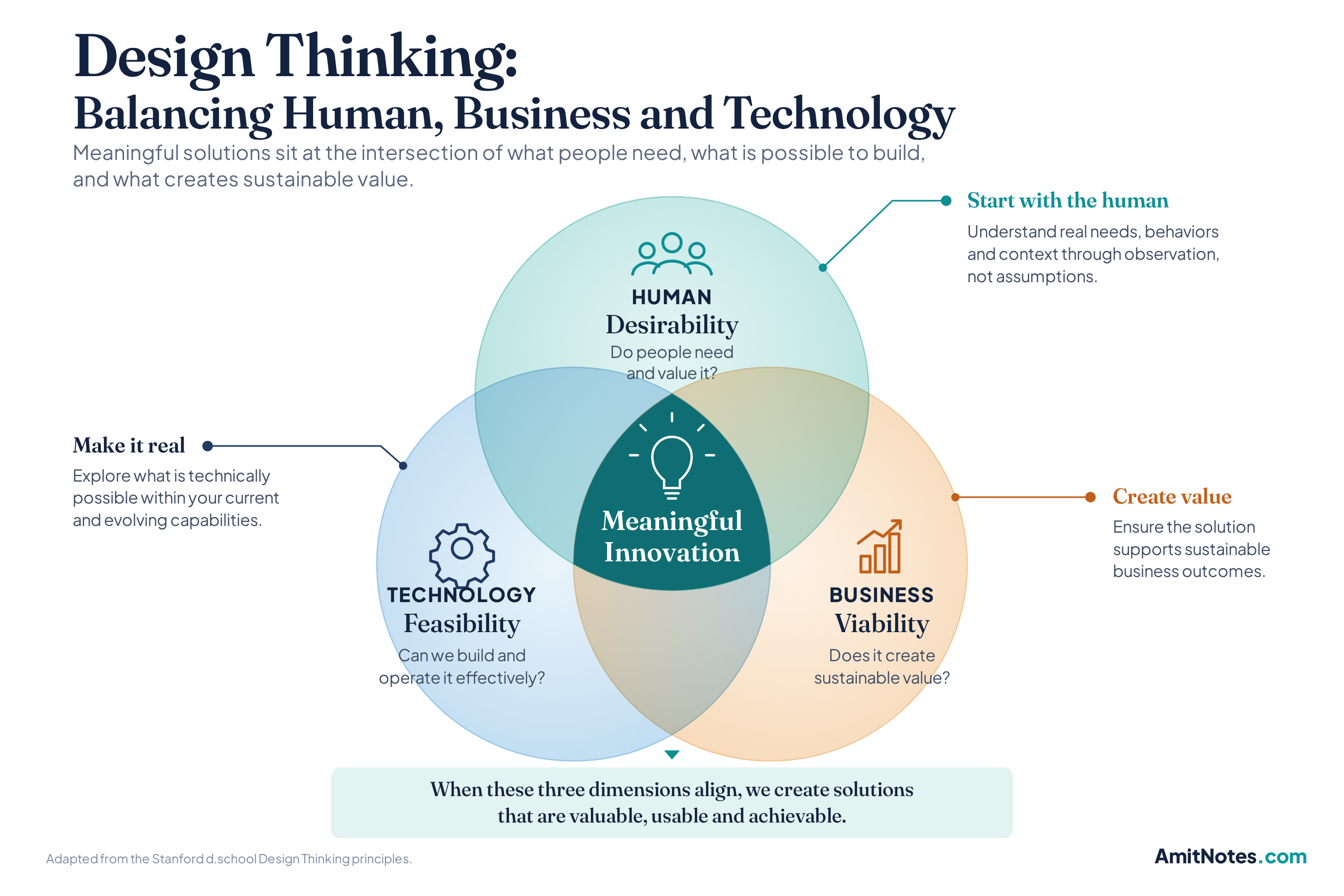
Tim Brown of IDEO says, “Design thinking is a human-centered approach to innovation that draws from the designer’s toolkit to integrate the needs of people, the possibilities of technology, and the requirements for business success.” Thinking like a designer can transform the way teams develop products, services, processes and strategy.
I was introduced to the principles of Design Thinking, and how to apply them, during a workshop I attended at the MIT Sloan School of Management in Boston. Since then, I have been an avid practitioner of Design Thinking at work and in my weekend volunteering to help address education inequality in our society. I have experienced immense benefits that are sometimes hard to quantify but easy to experience.
Here is a very good explainer video on Design Thinking from IDEO U that I recommend.
There are multiple methodologies for applying Design Thinking, but the core principles are the same. I follow the Design Thinking process laid out by the Stanford d.school, which has five steps:

- Empathize: Empathy is the foundation of human-centered design. Here you work to fully understand the experience of the user for whom you are designing. Do this through observation, interaction and immersing yourself in their experiences.
- Define: In the define mode, you unpack your empathy findings into needs and insights and scope a meaningful challenge.
- Ideate: The goal of ideation is to explore a wide solution space, with both a large quantity and a broad diversity of ideas. From this repository of ideas, you can build prototypes to test with users.
- Prototype: Prototyping gets ideas out of your head and into the physical world. Develop a low-cost physical model to experiment with your ideas. Using prototypes to drive interactions among the design team, users and other stakeholders builds deeper empathy and shapes successful solutions.
- Test: In the testing phase, you test your low-resolution prototype with a diverse set of user personas to gather feedback, refine solutions and continue to learn about your users.
All cross-functional members of agile teams should participate in the Design Thinking process, both to confirm that the problem they are solving really exists and to come up with a creative solution. The final solution should bring together what is desirable from a human point of view with what is technologically feasible and economically viable.
To summarize, Design Thinking is a multidisciplinary process that helps teams build innovative solutions to complex problems in a technically feasible, commercially sustainable and meaningful way. Applying Design Thinking techniques in Software Engineering to solve business problems can help teams offer greater value to customers, innovate and stay relevant. It is helping me make a big difference to the product we are developing, by addressing customers’ critical needs in a better way to improve customer experience and business productivity.
For a deeper dive into the Design Thinking process, here are some references:
- Design Thinking Bootleg from the Stanford d.school
- Design Thinking, Explained (MIT Sloan)
- Design Thinking Defined (IDEO)
I hope you found this blog post informative. If you have any questions or feedback, please leave a comment.
Continue the journey: In Design Thinking in the Age of AI, I revisit these principles and explore what changes when the products we design can interpret, recommend and increasingly act.
Leave a Reply