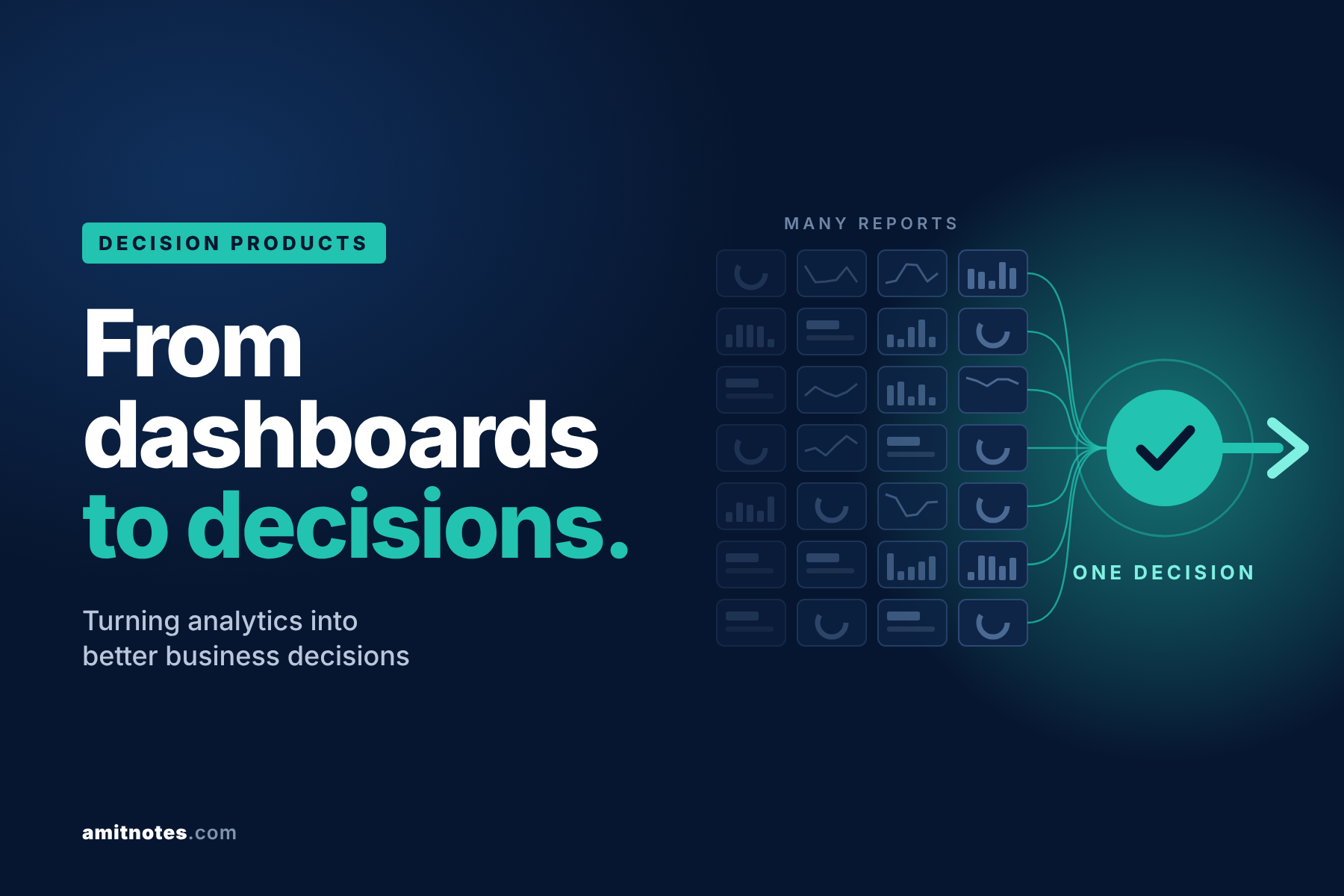
The next evolution of Business Intelligence needs a more practical unit of value: the Decision Product.
For years, BI has been organized around reports, scorecards, self-service views and analytics platforms. These assets helped organizations see performance more clearly. But as data platforms mature and AI becomes part of everyday analytics, the bigger question is no longer whether the business can see the numbers. It is whether the business can make better decisions from them.
Definition: A Decision Product is a governed, reusable business capability designed around a named, recurring decision. It brings together trusted metrics, business context, analytical and AI-driven insight, recommended actions and feedback loops so teams can move from signal to decision to action with confidence.
That sounds simple, but it changes the starting point of BI work. Instead of asking, “What report do we need?” the better question becomes: What decision are we trying to improve?
Why Business Needs Decision Products
Every mature business eventually reaches a familiar point. It has more reports than before, stronger platforms than before and more data available to more people. Yet teams still spend time reconciling numbers, debating definitions, requesting follow-up analysis and waiting for someone to translate performance signals into action.
This is a common industry challenge in data-rich organizations. The issue is rarely the absence of analytics; it is the gap between fragmented information and a decision-ready view of the business. Different teams may look at different cuts of revenue, margin, volume, customer, product or time period, and the discussion shifts from action to reconciliation.
The gap is not always access to data. Often, the gap is product design. A report shows what happened. A Decision Product is designed to support what happens next. That matters because most business decisions repeat every week, month or quarter. A sales leader reviews account performance. A revenue manager evaluates pricing action. A supply chain planner allocates constrained inventory. A finance leader investigates margin pressure. These decisions have owners, cadences, business rules, constraints and consequences. A Decision Product treats the decision itself as the product.
This is why business needs Decision Products. They are not simply the next version of BI. They are a business capability built on top of BI, data products, semantic layers and AI. BI helps the organization see what happened. Decision Products help teams decide what to do next, act with confidence and learn from the outcome.
A Commercial Decision in Motion
Imagine a commercial team in a consumer goods business facing a sudden raw-material cost increase.
Finance sees margin pressure in a monthly performance pack. Sales sees account-level volume softness. Revenue management sees that some customers are due for price review, while others are protected by contract terms. Supply chain is watching service levels and allocation risk. Everyone has a piece of the picture, but no one has the full decision context in one place.
The meeting starts with a familiar pattern. Which number is right? Is the margin movement driven by price, cost, volume or mix? Which customers are most exposed? Can the business pass through the increase? What happens to volume if prices move? Which accounts come first?
Now imagine the same situation supported by a Decision Product. It detects a margin movement against a governed KPI, decomposes the variance into price, volume, mix and cost drivers, identifies the customers and product groups most affected, and shows where action is commercially feasible. It then recommends a set of accounts for price review, shows the rationale and evidence, and tracks what happens after the action is taken.
The value is not only in seeing margin pressure earlier. It is in helping the team decide what to do about it. This example is useful because it shows the idea landing on one real decision instead of remaining a broad analytics concept.

The Anatomy of a Decision Product
A Decision Product begins with a recurring decision specific enough to design around. “Improve commercial performance” is too broad. “Identify which accounts need price review because cost movements are affecting margin” is much better. Around that decision, it brings together components that traditional BI often handles separately.
The strongest Decision Products usually have five building blocks.

By Golden KPIs I mean the small set of certified metrics that have one agreed definition, one accountable owner and traceable lineage back to source, so the same number means the same thing in every product that uses it.
The AI layer should be designed against these components, not added as a separate novelty. AI may explain drivers, personalize context, recommend action options and summarize feedback from prior decisions. Without a named decision, owner, action path and feedback loop, the experience is still analytics. With those elements in place, it becomes a product for better decision-making.
In practice, I use a simple canvas to design these with business teams. It condenses the work into nine design questions. The business question sits inside the decision, and the experience layer is chosen once the rest is clear. The canvas forces both sides to design the decision, not just the interface.

Here is the same canvas filled in for the margin example:
| Canvas | Margin Price Review Product |
|---|---|
| Decision | Which accounts need price review because input costs are eroding margin? |
| Owner | Revenue management lead, with sales account owners. |
| Cadence | Monthly, plus event-driven when a material cost move is detected. |
| Golden KPIs | Gross margin, price realization and volume. |
| Drivers | Price, volume, mix and input cost. |
| Context | Contract terms, renewal dates, customer importance and service levels. |
| Actions | Prioritized price-review list, phased increases, mix changes or promotion changes. |
| Trust | Certified margin definition, cost data freshness, lineage and visible caveats. |
| Feedback | Margin recovered and volume retained in the periods after action. |
The Decision Journey Loop
A Decision Product supports the full decision journey, not just one screen of it. The journey starts with a signal: margin drops, demand shifts, service risk increases, inventory tightens, a customer slows down or a promotion underperforms.
Next comes diagnosis: what changed and why. Then context: customer importance, contract terms, channel dynamics, inventory, supply, forecast, timing and commercial priorities. Only then can the user decide, act and learn from the outcome. In the margin example, the signal is the cost move, diagnosis splits the variance into price, volume, mix and cost, and context separates the accounts that can be repriced from those locked in by contract.
This is a loop, not a straight line. A report can support part of the journey. A Decision Product is designed around the whole loop.

How Analytics Work Changes
The shift is easiest to see side by side.
| Traditional BI Development | Decision Product Development |
|---|---|
| Starts with a reporting request. | Starts with a recurring business decision and its owner. |
| Success is measured by delivery and usage. | Success is measured by decision quality, speed and business impact. |
| Metrics may be embedded in individual reports. | Metrics are governed through Golden KPIs and semantic definitions. |
| Analysis often stops at performance visibility. | Analysis continues into drivers, context, actions and outcomes. |
| Output is a report, scorecard or analytical view. | Output may be a view, alert, chat, recommendation or workflow. |
| Changes arrive as enhancement requests. | Changes are product iterations driven by feedback and value. |
The Techno-Functional Spine of a Decision Product
A Decision Product is not only a business concept and not only a technology pattern. It is techno-functional by nature. The functional side defines the decision, the owner, the questions, the actions and the outcome measures. The technical side makes those choices reliable through semantic models, data products, AI services, governance, observability and workflow integration.
This is why Decision Products are different from ordinary analytics assets. A report can be built around a dataset. A Decision Product has to be built around the way a decision is actually made, and then supported by the right technical foundations.

In the margin example, the functional need is to decide which accounts should move into price review. The technical foundation includes governed margin and price realization metrics, customer and product hierarchies, input cost feeds, contract terms, driver decomposition, recommendation logic and a way to capture whether the action protected margin without damaging volume.
That combination is what makes the product useful. Without the functional design, the technology produces disconnected insights. Without the technical foundation, the decision experience loses trust.
The Role of AI-Native Consumption
AI gives Decision Products their next level of leverage. It changes the experience from passive consumption to guided decision support. Users can ask natural-language questions, get a summary of what changed, see drivers explained, receive alerts on anomalies, review recommended next actions and capture learning from previous decisions. BI starts to feel less like a place to look for information and more like a decision partner.
In the margin example, AI could monitor cost movements, detect margin risk earlier, explain whether the impact is coming from price, volume, mix or input cost, summarize which customers are most exposed, and draft a recommended price-review list with the evidence attached.
But AI is not a shortcut around business design. If metrics are not governed, AI will answer with confidence but not necessarily with truth. If the decision owner is unclear, recommendations have no accountable user. If action options are undefined, AI may explain the problem but fail to move the business forward.
The maturity path should be gradual, and each step earns the next.

The goal is not autonomous decision-making everywhere. It is better human and organizational decision-making, supported by AI where it is trusted and useful.
What It Takes to Do This Well
A semantic layer behind the product
Decision Products cannot scale without a trusted semantic foundation. The semantic layer defines the business meaning of metrics, dimensions, entities and relationships, so that revenue, margin, customer, product, region, channel and time period mean the same thing across experiences. This matters even more with natural language. If a user asks why margin declined in a region last month, the system must know which margin definition to use, what the region means, what time period applies and which data is certified for that answer. In the old model, logic lived inside individual reports. In the Decision Product model, meaning is curated once and reused everywhere.
Trust, governance and explainability
A wrong number in a report is a problem. A wrong recommendation delivered at speed is a much bigger business risk. Trust starts with transparency: users should see which KPI definition was used, where the data came from, how fresh it is and what caveats apply. Evidence should travel with every recommendation. AI-enabled experiences also need evaluation: benchmark question sets, human review, answer quality scoring and monitoring for accuracy, relevance, completeness and consistency. The goal is not heavy governance. It is to make trusted decision-making easier.
Knowing when a simpler view is enough
Not every analytics need should become a Decision Product. Broad monitoring, exploratory analysis, one-time investigation and executive visibility may not need a full decision loop. Decision Products earn their cost when the decision is recurring, valuable, cross-functional, time-sensitive or hard to make consistently: pricing action, customer growth, margin recovery, demand risk, supply allocation and service recovery. They are also harder to build than ordinary analytics assets. The hard part is not only technology but ownership, definition alignment, accountability and value attribution, which is exactly why they matter.
Getting Started and Measuring What Matters
Building Decision Products requires BI to operate more like a product function. The work becomes cross-functional: business owners define the decision, BI teams design the experience, data teams ensure reliable data products, semantic engineers model the metrics and AI teams build assistants and agents. This does not always need a large new organization, but it does need a different mindset. A report can be delivered and left alone. A Decision Product needs to be owned, measured, improved and sometimes retired.
The best way to start is with one or two lighthouse decisions. Do not start with the platform or a long catalogue of reports. Start where business value is high and data readiness is good enough to move. Margin management, customer growth, demand risk, supply allocation and pricing review are all strong candidates. Keep the first version narrow, and fill in the canvas before anything is built.
The first version does not need advanced AI. The margin product could launch with governed margin KPIs, a price-volume-mix-cost bridge and a simple price-review workflow. Once that foundation is trusted, conversational questions, proactive cost alerts and drafted recommendations can follow.
Measure it by the decision, not by usage alone. A product can be used often and still fail to improve the decision. Better measures are time from signal to action, confidence in the decision, reduction in manual analysis, alignment across functions, actions taken earlier and improvement in business outcomes. For the margin product, that means how many days pass between a cost move and the first price conversation, and how much margin is recovered without losing volume. Where AI is involved, track answer accuracy, relevance, completeness and consistency over time, especially where decisions carry financial or customer impact.
Final Thought
Decision Products give business and analytics teams a practical path into the AI and Decision Intelligence era. They move the focus from analytics outputs to business decisions, and they give teams a clearer product shape and a direct line to business value. AI will make the shift more visible, but AI alone is not the answer. The advantage comes when AI is grounded in trusted metrics, business context, decision ownership and feedback loops.
The future of Business Intelligence is not about knowing more. It is about deciding better.
Leave a Reply