From probabilistic intelligence to governed, context-aware and auditable enterprise workflows
Generative AI has made it remarkably easy to build impressive prototypes. Give an LLM a document, connect it to enterprise data, add a few tools and agents, and within days you can demonstrate something that looks intelligent.
But building an AI system that an enterprise can actually trust is a very different challenge.
In enterprise environments, generating a good answer is only part of the equation. The system must understand business context, operate within defined controls, validate critical outputs, recognize uncertainty, involve humans when necessary, and provide evidence of how a decision was reached.
This became particularly clear while building an Invoice Intelligence Agent — a governed, multi-agent workflow designed to process invoices through multimodal extraction, validation, vendor verification, safety controls, human review and auditability.
The use case is invoice processing. But the architecture pattern is much broader.
It applies to claims, procurement, finance operations, compliance, customer operations and many other enterprise processes where AI is moving from generating information to participating in decisions and actions.
The LLM Is Not the Enterprise AI System
One design principle became fundamental:
Use AI for what requires intelligence. Use deterministic systems for what requires certainty.
A vision-language model is very good at interpreting an invoice it has never seen before — understanding an unfamiliar layout, identifying a vendor, reading line items and converting unstructured information into structured data.
But should we ask an LLM whether:
Quantity × Unit Price = Line Total?
Probably not.
Traditional code can calculate that deterministically.
The same principle applies elsewhere. AI may help identify a vendor from noisy or inconsistent information, but tax IDs, currencies and bank details should ultimately be verified against trusted enterprise data.
This creates an important separation:
LLMs interpret. Deterministic systems verify. Enterprise context grounds. Agentic workflows decide.
And that leads to a broader architecture pattern.
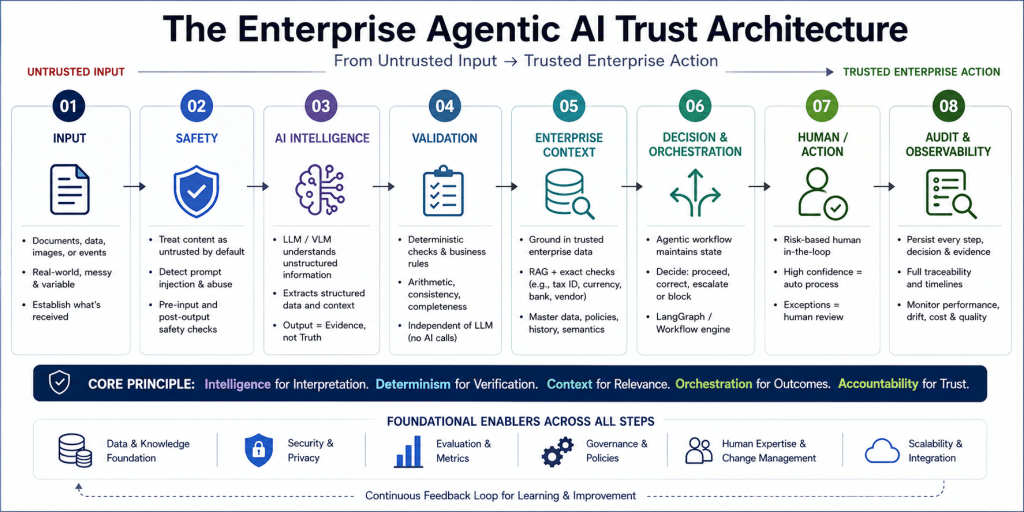
An 8-Step Pattern for Enterprise Agentic AI
Input → Safety → AI → Validation → Enterprise Context → Decision → Human / Action → Audit
This is a simple way to think about the layers required around an LLM when moving from an AI prototype toward an enterprise capability.
01 — Input
Enterprise AI starts with real-world inputs — documents, transactions, images, conversations, events or business data.
These inputs are rarely perfect. They can be incomplete, inconsistent, noisy or potentially malicious.
Before asking what AI can do with the information, we first need to establish what has entered the system and whether it can be trusted.
02 — Safety
As AI becomes connected to business processes, external content should be treated as untrusted by default.
In the Invoice Intelligence Agent, documents are screened before the extraction model processes them. The workflow includes controls designed to identify suspicious embedded instructions and potential prompt-injection patterns.
There is also an output safety layer before information is released downstream.
The broader principle is important:
AI safety cannot simply be another instruction inside the prompt. It needs to be part of the system architecture.
03 — AI
This is where probabilistic intelligence adds significant value.
A vision-capable model can understand variable invoice layouts and extract structured information such as vendor details, dates, line items, taxes and totals.
This is precisely where GenAI is powerful — understanding information whose structure cannot easily be predetermined.
But the model output should be treated as evidence, not automatically as truth.
04 — Validation
Once something can be proven deterministically, it should be.
Extracted information therefore goes through independent checks for required fields, dates, line-item arithmetic, subtotals, taxes and totals.
These validations don’t require an LLM.
This separation is critical when designing enterprise AI:
Use probabilistic intelligence for interpretation and deterministic controls for certainty.
05 — Enterprise Context
This may be one of the most important layers for scaling enterprise AI.
A model can understand an invoice. But it does not inherently know whether the vendor is legitimate, which master record is authoritative, whether bank details are correct, or which enterprise policy should apply.
That requires enterprise context.
In the Invoice Intelligence Agent, vendor verification combines retrieval with governed vendor information and deterministic checks such as tax ID, currency and bank details.
At enterprise scale, that context becomes much richer:
Master Data • Business Semantics • Policies • Historical Transactions • Domain Knowledge • Permissions • Enterprise Systems
This is why I increasingly see context engineering as an enterprise capability, not simply an LLM engineering technique.
Models will continue to improve.
But the quality of enterprise AI will increasingly depend on the quality of the business context surrounding those models.
06 — Decision
This is where agentic AI becomes particularly interesting.
Agentic architecture is not about creating as many agents as possible.
It is about orchestrating intelligence, context, evidence and controls toward an outcome.
The workflow maintains state and determines what happens next based on the evidence collected.
A validated invoice from a verified vendor can proceed.
A validation issue may trigger a bounded correction.
An unknown or mismatched vendor can trigger human review.
A suspicious document can be blocked.
The intelligence therefore lies not only in what the model generates, but also in how the system determines the next best action.
07 — Human / Action
Human-in-the-loop should not mean putting a human behind every AI decision.
That simply recreates the manual process with AI sitting in front of it.
Instead, human involvement should be risk-based and exception-driven.
High-confidence and independently validated cases can progress automatically.
Uncertain vendor identity, conflicting business information, unresolved validation failures or safety concerns should trigger human review.
The goal is not maximum autonomy.
The goal is appropriate autonomy.
08 — Audit
Finally, enterprise AI needs a record of what happened.
For every transaction, we should be able to understand what the AI extracted, what was validated, what enterprise context was retrieved, what corrections were made, why something was escalated and what final action was taken.
This becomes increasingly important as AI starts participating in business processes rather than simply answering questions.
Auditability should not be added after an AI solution reaches production. It should be designed into the architecture from day one.
Evaluation Has to Move Beyond Model Accuracy
Another important lesson is that evaluating enterprise AI cannot stop at:
“How accurate is the model?”
Model accuracy matters, but enterprise systems require a broader set of measures.
For the Invoice Intelligence Agent, the evaluation framework considers dimensions such as:
- First-pass extraction accuracy
- Post-correction accuracy
- Correction and human-review rates
- Safety precision and recall
- Vendor retrieval performance
- Latency
- Cost per processing run
The more important enterprise questions become:
How often can the process operate autonomously?
How often does it require human intervention?
How effectively does it detect risk?
How reliably is it grounded in enterprise data?
What does each successful transaction cost?
Can we explain why the system made a decision?
These are system-level questions, not simply model-level metrics.
From AI Prototypes to Enterprise Decision Systems
The biggest takeaway for me from building this architecture is that the sophistication of the model is only one dimension of enterprise AI maturity.
As organizations move from copilots and conversational AI toward agents and decision intelligence, the architecture surrounding the model becomes increasingly important.
Context. Controls. Safety. Evaluation. Orchestration. Observability. Human Judgment. Governance.
The LLM provides intelligence.
The surrounding system creates trust.
And ultimately, that is what turns an impressive AI prototype into an enterprise capability that can participate safely and meaningfully in business decisions at scale.
About the Project
The Invoice Intelligence Agent was developed as part of my capstone project IISc Advanced Certification Programme in Agentic and Generative AI.
The implementation explores a governed agentic architecture combining multimodal AI, LangGraph orchestration, deterministic validation, RAG-based vendor verification, layered safety controls, bounded correction, human-in-the-loop routing, evaluation and persistent auditability.
While invoice processing was the use case, the broader architecture can be applied across document intelligence, claims, procurement, finance, compliance and other enterprise workflows.
 AmitNotes.com
Leave a comment