From business productivity to decision intelligence — how foundation models, transformers, agents, and production AI systems are reshaping work
Every organization is under pressure to move faster: faster decisions, faster insights, faster product innovation, faster customer response, and faster execution. Yet most enterprise knowledge still sits across reports, documents, dashboards, emails, codebases, policies, and systems that people must manually search, interpret, and connect.
Generative AI changes this equation.
It gives organizations a new way to interact with knowledge. Instead of only searching for information, users can ask questions. Instead of only reading reports, they can receive summaries, explanations, and recommendations. Instead of manually writing code, documents, or analysis, they can collaborate with AI systems that generate, refine, and act. This is why Generative AI is not just a technology trend. It is becoming a new productivity and decision-intelligence layer across the enterprise.
For business leaders, the promise is clear: reduce time spent finding information, improve the quality of decisions, automate repetitive knowledge work, and create more personalized experiences for customers and employees. For technology leaders, the challenge is equally clear: understand how these systems work, how to adapt them to enterprise knowledge, how to deploy them safely, and how to govern them responsibly.
At the foundation of this shift is a powerful technical idea: instead of programming every rule, we train large models to learn probability distributions over massive datasets. These models generate new outputs by estimating what is most likely, useful, or contextually appropriate given an input.
A useful way to understand the full journey is this:
Generative AI begins with probabilistic language modeling, scales into foundation models, is powered by transformers, adapted through prompting, RAG, and fine-tuning, extended through agents, operationalized through LLMOps, and advanced through frontier innovation.
This article explains that journey from both perspectives: the business outcomes Generative AI enables and the technical foundations that make those outcomes possible.
What is Generative AI?
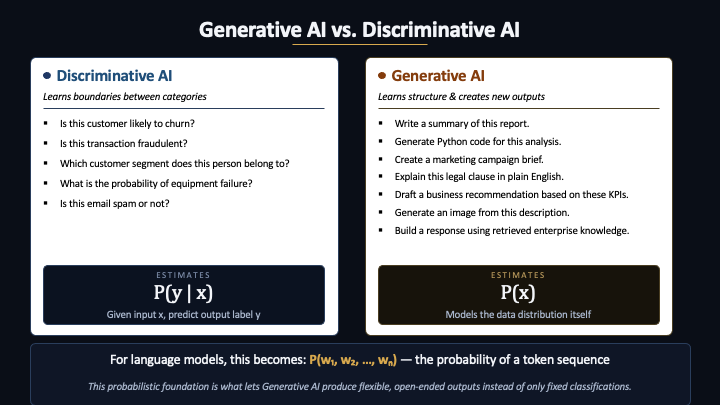
Generative AI refers to artificial intelligence systems that create new content by learning patterns from existing data. This content can include text, images, code, audio, video, presentations, reports, molecules, simulations, or structured business outputs. Unlike traditional discriminative AI, which predicts labels or categories, generative AI produces new samples.
A discriminative AI model might answer: Is this transaction fraudulent — yes or no?
A generative AI model might answer: Draft a customer response explaining why the transaction was flagged, summarize the risk indicators, and recommend the next action. This distinction matters. Traditional AI is mostly about classification, prediction, and optimization. Generative AI is about creation, synthesis, reasoning, interaction, and increasingly action.
A simple way to define it is: Generative AI learns the structure of data and uses that learning to generate new, contextually meaningful outputs.
The explosion of Generative AI became visible through tools such as ChatGPT, Claude, Gemini, Midjourney, DALL·E, GitHub Copilot, Perplexity, and many others. But the foundation behind these tools comes from decades of progress in neural networks, language modeling, representation learning, attention mechanisms, and large-scale self-supervised training. Today, Generative AI powers writing assistants, enterprise search, code generation, customer support agents, document intelligence, research assistants, multimodal copilots, business intelligence assistants, and autonomous AI agents.
Generative AI vs. Discriminative AI
How Does It Work? The Core Idea
At the heart of every generative AI system is a model that has learned the statistical patterns of human language (or images, or code) from an enormous dataset. The two most important concepts to understand are:
Language Models and Next-Token Prediction
The most widely used Generative AI systems today are large language models, or LLMs. A language model is trained to predict the next token in a sequence. A token may be a word, part of a word, punctuation mark, number, symbol, or code fragment.
For example, given the phrase: The quarterly sales declined because
A language model may assign probabilities to possible next tokens such as: competition, demand, pricing, inventory, promotion, distribution ? The model does not look up the answer in a database. It estimates probabilities based on patterns learned during training.
Formally, a language model estimates:
P(wₜ | w₁, w₂, …, wₜ₋₁)
In plain terms: given everything that came before, what’s the probability of the next token?

A full sequence is just this calculation repeated and chained together, using the chain rule of probability:
P(w₁, w₂, …, wₙ) = ∏ₜ₌₁ⁿ P(wₜ | w₁, …, wₜ₋₁)
This process is called autoregressive generation: the model produces one token at a time, and each new token immediately becomes part of the context used to predict the next one.

It sounds almost too simple to explain how these systems write code, reason through problems, or hold a conversation. But repeated across trillions of tokens and tuned across billions of parameters, next-token prediction forces the model to internalize grammar, facts, style, reasoning patterns, code syntax, domain concepts, and conversational structure — all without ever being explicitly taught any of it.
That’s the underlying power of self-supervised learning: the data itself becomes the training signal.
From Language Models to Foundation Models
A foundation model is a large-scale neural network trained on broad, diverse data using self-supervised learning. It produces a general-purpose representation that can be adapted to many downstream tasks with minimal additional training.
This is a major shift from the earlier AI paradigm. In the past, teams trained separate models for separate tasks: one model for sentiment analysis, another for translation, another for classification, another for entity extraction, and another for summarization.
Foundation models changed this pattern. Instead of training a separate model for every task, we pre-train one large model on broad data and then adapt it to many tasks using prompting, retrieval, fine-tuning, tool use, or agentic workflows.

This is why they are called foundation models. They are not final applications by themselves. They are base capabilities on which many intelligent systems can be built.
The Transformer Architecture
If language models explain what Generative AI is trying to do — predict and generate the next token — the Transformer explains how modern AI systems do this at scale. Before transformers, most sequence models processed text step by step. Recurrent Neural Networks and LSTMs read one token after another, carrying information forward through a hidden state. This worked for short sequences, but it created two major limitations: training was slow, and long-range context was difficult to preserve.
The Transformer changed this by replacing sequential processing with attention. Instead of reading words one by one, a transformer looks at the full sequence and learns which tokens should influence each other. This allows the model to connect ideas across long distances — a pronoun with its subject, a business metric with its driver, a function call with its definition, or a question with the most relevant context in a document.
This is why the 2017 paper Attention Is All You Need became such a turning point. It introduced an architecture that could scale with data, compute, and model size — and that architecture became the foundation for GPT, Claude, Gemini, Llama, Mistral, BERT, T5, and many other modern AI systems.
A simple way to understand the transformer pipeline is:

This is why Generative AI feels conversational and creative, but underneath it remains probabilistic. It isn’t retrieving a fixed answer — it’s generating the next most appropriate token based on everything it has learned and everything provided in the current context.
The transformer is therefore the bridge between probability and intelligence-like behavior. It gives foundation models three powerful capabilities:
- Context awareness — each token can relate to every other relevant token.
- Parallel processing — the model trains efficiently on massive datasets.
- Scalability — larger models, more data, and more compute keep improving capability.
This is why every major frontier model today is built on transformer principles. What differs across GPT, Claude, Gemini, Llama, and Mistral is not the architectural family, but the training data, model size, alignment strategy, context length, inference optimization, safety design, and product integration.
For business leaders, the practical takeaway is simple: the transformer is not just a technical architecture — it is the engine that turns data, language, and context into intelligent interaction. It’s the reason a model can summarize a report, explain a KPI movement, generate code, answer questions from enterprise documents, reason over a conversation, and power AI agents that use tools.
Understanding the transformer helps us move beyond using Generative AI as a black box. It explains why prompting matters, why context matters, why RAG works, why hallucinations happen, and why production AI needs careful design.
How Generative AI Produces Output
After the transformer processes the input, the model produces a probability distribution over its entire vocabulary — in simple terms, it calculates which token is most likely to come next. This distribution is created using a function called softmax, which converts the model’s raw scores into probabilities. Every candidate token gets a probability score, and the model then selects or samples from that distribution.
But the final output isn’t just about probabilities — it’s shaped by decoding parameters that control how the model picks from the distribution:
- Temperature — Controls how predictable or creative output is. Low = focused and deterministic; high = more creative, more variable.
- Top-k sampling — Limits choices to the k most likely next tokens, preventing very unlikely words while allowing variation.
- Top-p (nucleus) sampling — Selects from the smallest group of tokens whose combined probability reaches a threshold — flexibility within a likely set.
- Maximum tokens — Caps response length, controlling output size, cost, and response time.
- Stop sequences — Tell the model exactly when to stop generating — useful for fixed formats or precise endpoints.
- Frequency penalty — Reduces repetition of words and phrases already used.
- Presence penalty — Encourages introducing new ideas and terms rather than staying close to what’s already been generated.
This is why Generative AI is fundamentally probabilistic. The same prompt can produce slightly different answers depending on model settings, context, and sampling approach. The model isn’t executing fixed logic — it’s generating from a learned probability distribution shaped by training data, prompt context, and decoding choices.
The Generative AI Capability Stack
Generative AI is not a single technology. It’s a layered capability stack — starting with foundation models and extending up through applications, agents, production systems, and frontier innovation. A simple way to understand the journey: foundation models provide the capability, transformers provide the architecture, adaptation techniques shape the behavior, applications and agents create user value, LLMOps makes the system production-ready, and innovation creates the next generation of AI capabilities.

- Level 1: Foundation Models -> The base layer — large pre-trained models like GPT, Claude, Gemini, Llama, and Mistral that learn broad patterns from massive datasets. Their power lies in generality: one model can summarize, translate, write code, answer questions, reason over documents, and support countless downstream tasks.
- Level 2: Model Adaptation -> A foundation model is powerful, but most real-world use cases need specialization — aligning the model to a specific task, domain, tone, or knowledge base. The three common strategies: prompting changes the instruction, RAG changes the context, and fine-tuning changes the model’s behavior.
- Level 3: Applications and Agents -> Here models become usable products — chatbots, copilots, coding assistants, enterprise search, document intelligence, and BI assistants. Agentic AI extends this further: agents don’t just answer questions, they reason, use tools, observe results, and take actions across multi-step workflows.
- Level 4: Integration and LLMOps -> A working prototype is not a production system. Production GenAI needs reliability, monitoring, cost control, latency management, safety guardrails, evaluation, and governance. LLMOps ensures AI systems are not only intelligent, but scalable, secure, measurable, and trustworthy.
- Level 5: Innovation -> The frontier — pre-training new foundation models, designing better architectures, building scientific AI systems, and developing autonomous research agents. Innovations here become the foundation for the next wave of applications.
The key takeaway: Generative AI should be understood as an end-to-end system, not just a chatbot interface. Real value comes when foundation models are adapted, integrated, governed, and applied to meaningful business and human problems.
Key Technologies at a Glance
Generative AI is powered by a combination of models, architectures, adaptation techniques, and production engineering practices. Each technology plays a different role in moving from raw model capability to real-world intelligent systems.
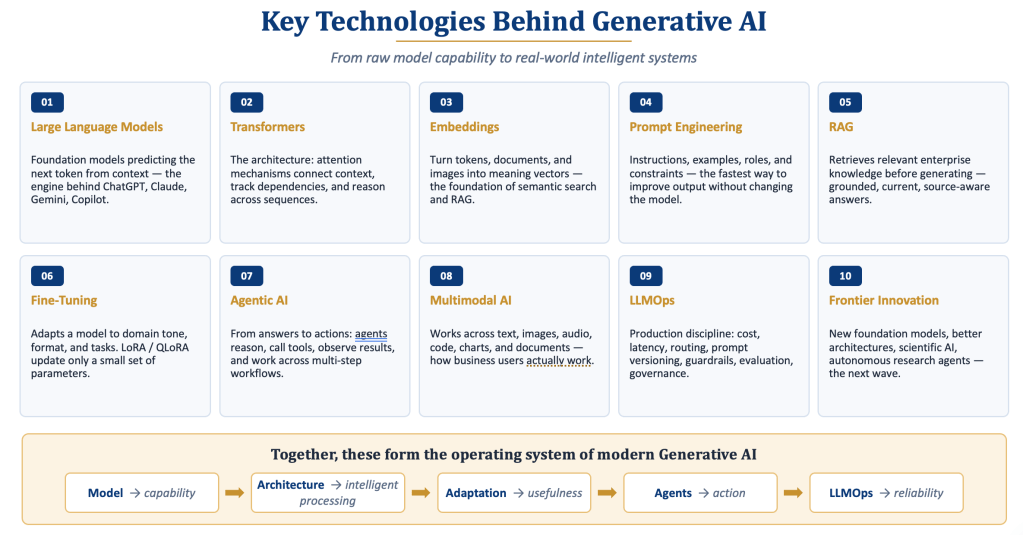
- Large Language Models : LLMs, are foundation models trained on massive volumes of text, code, and other data. They generate responses by predicting the next token based on the context provided. LLMs are the core engine behind tools such as ChatGPT, Claude, Gemini, Copilot, and many enterprise AI assistants.
- Transformers – Are the architecture behind most modern Generative AI systems. They use attention mechanisms to understand relationships between tokens across a sequence. This is what allows models to connect context, understand dependencies, summarize long documents, generate code, and reason across conversations.
- Embeddings – Convert tokens, documents, images, or other data into numerical vectors. These vectors help models represent meaning in a mathematical space. Embeddings are also the foundation for semantic search and RAG, where user questions are matched with the most relevant documents or knowledge chunks.
- Prompt Engineering – Is the practice of guiding model behavior through clear instructions, examples, roles, and constraints. It is often the fastest way to improve output quality without changing the model.A good prompt shapes the context, clarifies the task, and helps the model generate more useful, structured, and relevant responses.
- Retrieval-Augmented Generation – RAG, connects the model to external knowledge before it generates an answer. Instead of relying only on what the model learned during training, RAG retrieves relevant information from documents, databases, or enterprise knowledge systems. This makes responses more grounded, current, and useful for business scenarios where accuracy and source context matter.
- Fine-Tuning – Adapts a pre-trained model by training it further on domain-specific examples. This helps the model learn a specific tone, format, vocabulary, or task behavior.Techniques such as LoRA and QLoRA make fine-tuning more practical by updating only a small set of parameters instead of retraining the full model.
- Agentic AI – Extends Generative AI from answering questions to taking actions. An agent can reason through a goal, call tools, observe results, and continue working across multiple steps.This is the shift from simple chatbots to AI systems that can search, analyze, write code, query databases, create reports, and support real workflows.
- Multimodal AI – Multimodal AI systems can work across text, images, audio, video, code, charts, and documents. They allow users to interact with AI in a more natural way, using the same types of information humans use every day.This is important because real-world work is not only text-based. Business users often think through dashboards, presentations, spreadsheets, diagrams, screenshots, and conversations.
- LLMOps – LLMOps is the discipline of deploying, monitoring, evaluating, and governing Generative AI systems in production. It includes cost control, latency monitoring, model routing, prompt versioning, safety guardrails, and quality evaluation. Without LLMOps, a promising AI prototype may fail when exposed to real users, real data, changing requirements, and enterprise-scale usage.
- Frontier Innovation – Frontier innovation focuses on creating the next generation of AI capabilities. This includes pre-training new foundation models, improving transformer architectures, building scientific AI systems, and developing autonomous research agents.This is where Generative AI moves beyond productivity improvement and starts contributing to new forms of discovery, design, and knowledge creation.
Together, these technologies form the operating system of modern Generative AI. The model provides capability, the architecture provides intelligence-like processing, adaptation makes it useful, agents make it actionable, and LLMOps makes it reliable.
The Major Generative AI Model Families
The Generative AI landscape is changing very quickly. New models ship every few months, and competition is no longer about who has the largest model. The market is moving toward a portfolio of models optimized for different needs: deep reasoning, coding, multimodal understanding, enterprise workflows, low-cost inference, long-context processing, and agentic task execution. A simple way to understand the current landscape is to group models by provider and strength:
| Model Family | Provider | Known for | Typical use cases |
|---|---|---|---|
| GPT | OpenAI | Strong general intelligence, reasoning, coding, tool use, and multimodal capability. The GPT-5.6 family spans Sol, Terra, and Luna variants across cost-performance tiers. | ChatGPT, enterprise copilots, coding, analysis, agents, multimodal apps |
| Claude | Anthropic | Writing quality, long-form reasoning, coding, safety-focused design, and enterprise-grade assistant behavior — spanning Fable 5, Opus 4.8, Sonnet 4.6, and Haiku 4.5 across intelligence, speed, and cost. | Research, writing, coding, enterprise assistants, long-context analysis, agentic workflows |
| Gemini | Google DeepMind | Native multimodality, strong reasoning, and deep Google ecosystem integration — Pro tiers for complex reasoning, Flash/Flash-Lite for speed and cost. | Multimodal search, coding, document analysis, voice agents, Workspace/Cloud AI |
| Llama / Meta AI | Meta | The open-weight ecosystem that accelerated the open-model movement — developer adoption, fine-tuning, self-hosted deployment. | Open experimentation, enterprise self-hosting, fine-tuning, private deployments |
| Mistral | Mistral AI | Efficient open and commercial models, strong European ecosystem — coding (Devstral), audio (Voxtral), OCR, and deployable enterprise models across Small/Medium/Large tiers. | Enterprise AI, coding, document AI, multilingual workflows, cost-efficient inference |
| DeepSeek | DeepSeek AI | Cost-efficient reasoning and coding, strong open-model influence, efficient architectures — V4 Flash and V4 Pro at disruptive price points. | Reasoning, coding, math, cost-sensitive deployment, open-model research |
| Grok | xAI | Real-time web/X-connected assistant experience, coding, tool use, configurable reasoning — Grok 4.5 as the flagship. | Coding, real-time assistance, tool calling, business agents |
| Command / Aya / Embed | Cohere | Enterprise-focused: RAG, tool use, multilingual generation, embeddings, private deployment — Command A+ for vision/reasoning/agents, Embed v4 for text and image embeddings. | Enterprise RAG, semantic search, multilingual assistants, regulated industries |
| Qwen | Alibaba Cloud | Strong open and proprietary family — multilingual, coding, vision, agentic; dense and MoE models across a wide parameter range. | Multilingual AI, coding, open-model development, Asian-market enterprise AI |
| Nemotron | NVIDIA | Efficient open intelligence models optimized for reasoning, agents, and throughput on NVIDIA infrastructure — Nano, Super, and Ultra variants. | Enterprise agents, high-throughput inference, NVIDIA-based AI infrastructure |
The important point: there is no single “best” model for every use case. The right model depends on the workload.
For deep reasoning or complex coding, frontier models from OpenAI, Anthropic, Google, xAI, Mistral, DeepSeek, and Qwen all compete. For enterprise RAG and private deployment, Cohere, Mistral, and Llama-based open-weight models are attractive. For multimodal work, Gemini, GPT, Claude, Grok, and Cohere’s vision models are relevant. And for cost-sensitive, high-volume workloads, the smaller, faster variants matter most: GPT-5.6 Luna, Gemini Flash/Flash-Lite, Claude Haiku, Mistral Small, DeepSeek Flash, and compact open models.
The practical takeaway:
Model selection is no longer about choosing the biggest model. It is about choosing the right model for the task, cost, latency, privacy, reasoning depth, context length, and deployment environment.

All of these models share the same transformer architecture. What differentiates them is training data, scale, fine-tuning approach, and safety alignment choices.
Model Adaptation: Prompting, RAG, and Fine-Tuning
A foundation model is powerful because it is general-purpose. But most real-world use cases are not general. They are specific to a task, domain, business process, tone, data source, or user workflow.
For example, an enterprise AI assistant may need to answer questions from internal policies. A sales intelligence assistant may need to explain KPI movement using trusted business data. A legal assistant may need to draft clauses in a specific structure. A customer support bot may need to follow brand tone and escalation rules.
This is where model adaptation becomes important. Model adaptation is the process of shaping a foundation model so that it performs better for a specific purpose. The three most common approaches are:
| Adaptation Strategy | What it does | Best used when |
|---|---|---|
| Prompt Engineering | Guides the model using instructions, examples, roles, and output formats. | You need quick improvement without changing the model. |
| Retrieval-Augmented Generation (RAG) | Retrieves relevant external knowledge and adds it to the prompt before generation. | The model needs private, current, or source-grounded information. |
| Fine-Tuning | Trains the model further on curated examples to adjust its behavior. | You need consistent domain-specific style, format, or task performance. |
Prompt Engineering
Prompt engineering is the fastest way to adapt a model. It does not require training data, infrastructure, or model weight updates. Instead, it improves output by giving the model clearer instructions and better context. A good prompt defines the role, task, constraints, input context, and expected output format. For example:
You are a senior business analyst. Summarize the following sales performance data into three executive insights, two risks, and three recommended actions.
Prompting is useful for summarization, drafting, classification, ideation, analysis, and structured responses. It should usually be the first approach because it gives the fastest feedback loop. However, prompting has limits. It cannot permanently teach the model new knowledge. It is bounded by the context window and can be sensitive to wording changes.
Retrieval-Augmented Generation
Retrieval-Augmented Generation, or RAG, connects the model to external knowledge at the time of generation.
Instead of relying only on what the model learned during training, a RAG system first retrieves relevant information from documents, databases, knowledge bases, or enterprise systems. That information is then added to the prompt so the model can generate a grounded answer.
A simple RAG flow looks like this:
User question → Retrieve relevant knowledge → Add context to prompt → Generate grounded answer
RAG is especially useful for enterprise use cases because business knowledge changes frequently. Policies, pricing rules, sales reports, product documentation, and market updates should not be baked permanently into a model. They should be retrieved when needed.
The biggest benefit of RAG is grounding. It helps reduce hallucinations by giving the model trusted source material. The biggest limitation is retrieval quality. If the wrong documents are retrieved, the answer may still be weak or misleading.
Fine-Tuning
Fine-tuning adapts the model by continuing training on curated examples. Unlike prompting and RAG, fine-tuning updates the model’s behavior.
Fine-tuning is useful when the model needs to consistently follow a specific tone, format, vocabulary, or task pattern. For example, it can help a model write in a legal style, generate SQL from business questions, classify support tickets, or summarize performance in a standard executive format.
Full fine-tuning can be expensive because it updates many model parameters. This is why techniques such as LoRA and QLoRA are important.
LoRA freezes the base model and trains small adapter layers instead of updating the full model. QLoRA goes further by using quantized models to reduce memory requirements. These methods make fine-tuning more practical and cost-efficient.
How to Choose the Right Approach
A practical decision rule is:
- Start with prompting when the task can be solved with better instructions or examples.
- Add RAG when the model needs private, current, or source-grounded knowledge.
- Use fine-tuning when you need persistent behavior change and have enough high-quality training examples.
In production, these methods are often combined. A strong enterprise AI system may use a well-designed system prompt, retrieve trusted business context through RAG, and use a fine-tuned model or adapter for domain-specific response quality. The key takeaway is simple:
The value of Generative AI does not come only from the base model. It comes from how well the model is adapted to the task, grounded in the right context, and integrated into the workflow.
Agentic AI: From Answering to Acting
The next major shift in Generative AI is the move from models that only answer questions to systems that can take action.A chatbot responds to a prompt. An agent works toward a goal. Agentic AI systems can understand a task, reason through the next steps, use tools, observe results, and continue until the work is complete.
This is often described through the ReAct pattern: Reason → Act → Observe → Reason again
For example, if a user asks: Why did revenue decline in the Northeast region last week?
A basic chatbot may provide a general explanation. An agentic business intelligence system can query sales data, check pricing and promotion changes, review inventory availability, identify drivers, and generate a structured recommendation.
An AI agent typically has four components:
| Component | Role |
|---|---|
| Perception | Receives user input, documents, data, or tool results. |
| Memory | Maintains context, history, and relevant knowledge. |
| Reasoning | Uses the model to plan and decide next steps. |
| Action | Calls tools, APIs, databases, code, or workflows. |
Agents become powerful when connected to tools such as web search, SQL databases, Python, spreadsheets, enterprise systems, and knowledge bases. This allows them to move beyond text generation into real task execution.
Multi-agent systems extend this idea further by using specialized agents — for example, a planner agent, research agent, data agent, and critic agent — working together on complex tasks.
However, agentic systems also need strong governance. Once AI can take action, organizations need permissions, guardrails, audit logs, human approval for high-risk steps, and clear stopping conditions.
The key takeaway is:
Agentic AI is the shift from “AI that responds” to “AI that helps complete the work.”
For businesses, this is where Generative AI moves from conversation to decision support and workflow execution.
Where Generative AI is Used Today
Generative AI is no longer limited to writing emails or answering generic questions. It’s now applied across business functions where teams need to understand information faster, generate insights, automate work, and move from analysis to action.
In CPG, this is especially relevant because decisions depend on large volumes of data across sales, customers, categories, brands, promotions, pricing, supply chain, media, consumer behavior, and retail execution. The real opportunity isn’t content generation — it’s converting fragmented information into faster decisions.

- Business Intelligence & Decision Intelligence — Traditional BI delivers dashboards and reports. Generative AI adds a conversational and narrative layer on top. A business user can ask: “Why did revenue decline in this market last week?” The system summarizes KPI movement, identifies drivers, explains variance, highlights risks, and recommends follow-up questions — shifting BI from static reporting to dialogue with data. For CPG teams, that means faster understanding of sales performance, share movement, category growth, pricing impact, and promotion effectiveness.
- Sales & Commercial Performance — Instead of manually reviewing multiple reports, a sales leader can ask: “Which customers are driving the decline in snacks this month, and why?” The AI analyzes customer-level trends, compares against plan, summarizes drivers, and suggests actions — promotion review, distribution improvement, assortment correction, pricing intervention. Sales teams move from finding data to understanding what needs attention.
- Revenue Growth Management — RGM teams constantly evaluate pricing, promotions, mix, pack architecture, elasticity, and margin impact. Generative AI can summarize price-increase impact, promotion ROI, margin leakage, price-pack architecture opportunities, customer-level profitability, and trade spend effectiveness. Ask: “Which promotions delivered volume growth but diluted margin?” — and complex pricing data becomes a clear business narrative with recommended next steps.
- Retail Execution & Perfect Store — In CPG, store-level execution matters: availability, visibility, assortment, shelf placement, planogram compliance, display execution. A store visit assistant can answer: “What should I focus on in this store today?” — combining POS trends, inventory signals, planogram data, household behavior, and execution gaps into the most important actions for that visit. This is AI at the point of action, not just in corporate reporting.
- Category Management & Shopper Insights — Category managers can ask: “What is driving share loss in this category, and which shopper segments are most impacted?” The AI synthesizes category performance, consumer behavior, customer trends, and external signals into structured insight — accelerating the path from data exploration to category strategy.
- Marketing & Brand Performance — Campaign planning, content generation, brand performance analysis, media summaries, and consumer insight synthesis. “What themes are emerging from consumer feedback on this brand?” or “Summarize this campaign’s performance and suggest what to optimize.” For CPG brands, this speeds creative development, campaign learning, and brand narrative generation.
- Supply Chain & Demand Planning — A planner can ask: “Which SKUs are at risk of stockout next week, and what’s driving it?” The AI combines demand, inventory, production, logistics, and service-level data into a concise summary with mitigation actions — moving supply chain teams from exception tracking to proactive decision support.
- Customer & Account Management — Account teams juggle customer data, syndicated data, internal sales, promotion calendars, category insights, and joint business plans. “Prepare a customer performance summary for the upcoming business review.” The AI generates a structured view of growth, risks, opportunities, promotion performance, and recommended talking points — cutting preparation time and improving conversation quality.
- Knowledge Management & Enterprise Search — Large organizations hold thousands of documents, reports, policies, decks, and meeting notes. Generative AI with RAG turns this into a searchable, conversational experience with grounded, source-cited answers — valuable for onboarding, policy lookup, project continuity, and reusing prior work.
The Bigger Shift – Across all these use cases, the pattern is consistent. Generative AI helps teams move from:

For CPG companies, the value is not just efficiency. The bigger value is faster decision-making across commercial, consumer, customer, supply chain, and marketing workflows. Generative AI becomes most powerful when it is connected to trusted data, business context, and the real decisions teams need to make every day.
Limitations and Challenges
Generative AI is powerful, but it is not magic. It can generate fluent, useful, and context-aware responses, but it can also produce incorrect, biased, incomplete, or risky outputs if not designed and governed properly. Understanding these limitations is essential for responsible use, especially in enterprise and decision-making environments.
- Hallucinations – Generative AI models can confidently produce information that sounds correct but is factually wrong or unsupported. This is why high-impact use cases need grounding through trusted data, source citations, validation, and human review.
- Knowledge cutoff – Base models only know what they learned during training. They cannot access recent events, live business data, or internal enterprise knowledge unless connected to tools, RAG pipelines, databases, or web search.
- Context window limits – Models can only process a finite amount of information at one time. Larger context windows help, but they do not remove the need for good retrieval, chunking, prioritization, and prompt design.
- Bias and fairness – Models learn from human-generated data, and that data may include social, cultural, historical, or organizational biases. Without evaluation and guardrails, AI systems can reproduce stereotypes or generate unfair recommendations.
- Cost and compute -Large models can be expensive to run at scale. Input tokens, output tokens, embeddings, retrieval, reranking, tool calls, and latency all contribute to cost, which makes model routing, caching, quantization, and smaller specialized models important.
- Privacy and data security – Sending sensitive business, customer, employee, or financial data to third-party APIs can create privacy and compliance risks. Regulated industries may need private deployment, data masking, access controls, audit logs, or self-hosted models.
- Prompt sensitivity – Small changes in wording can change the model’s output. This happens because the prompt shapes the context, which influences attention patterns and the next-token probability distribution.
- Retrieval quality – RAG improves grounding, but it is only as good as the documents retrieved. If the retrieval layer brings back incomplete, outdated, or irrelevant information, the final answer may still be misleading.
- Evaluation difficulty – Traditional software can often be tested with fixed expected outputs. Generative AI produces open-ended responses, so quality must be measured through relevance, faithfulness, consistency, safety, usefulness, and business impact.
- Governance and accountability – As AI systems move from answering questions to supporting decisions and actions, governance becomes critical. Organizations need clear ownership, monitoring, human escalation, usage policies, and controls around what AI can and cannot do.
The practical lesson is simple: Generative AI should not be treated as an oracle. It should be treated as a powerful probabilistic system that needs grounding, validation, monitoring, and responsible human oversight.
Used well, Generative AI can accelerate insight and decision-making. Used carelessly, it can scale errors, bias, and misinformation just as quickly.
Where Generative AI is Heading
Generative AI is moving from simple content generation to intelligent systems that can reason, act, personalize, and support complex decision-making. The next phase will be defined by six major shifts.
- Agentic systems at scale – Enterprise software will increasingly include AI agents that can plan, use tools, coordinate with other agents, and complete multi-step workflows. The shift is from AI that only responds to AI that can help execute work.
- Multimodal by default – Future AI systems will not treat text, images, audio, video, charts, and documents as separate experiences. They will process multiple formats together as part of one unified intelligence layer.
- Smaller, specialized models – The future will not be only about bigger models. Smaller, fine-tuned, and domain-specific models will become more important because they can be faster, cheaper, easier to govern, and highly effective for focused tasks.
- AI in scientific research -Generative AI will continue accelerating discovery in medicine, materials, climate science, and engineering. Approaches such as Physics-Informed Neural Networks, AlphaFold-style systems, and scientific machine learning show how AI can move beyond content generation into knowledge creation.
- Personalization and memory – AI systems will become more context-aware over time. They will remember preferences, adapt to individual workflows, and maintain continuity across conversations, projects, and decisions.
- Regulation, safety, and governance – As AI becomes embedded in products and business processes, safety and governance will become as important as model capability. Bias, auditability, explainability, privacy, and human oversight will be critical for responsible adoption.
The next generation of Generative AI will not just answer questions. It will collaborate, create, research, recommend, and act alongside us. The key takeaway –
The future of Generative AI is not only smarter models. It is better systems — grounded in context, connected to tools, governed responsibly, and designed around real human and business decisions.
Conclusion: Generative AI as the New Intelligent Systems Layer
Generative AI is not just a better way to write text, summarize documents, or automate repetitive tasks. It represents a deeper shift in how humans interact with knowledge, systems, and decisions. At its foundation, Generative AI begins with a simple probabilistic idea: models learn patterns from massive datasets and generate outputs by estimating what is most likely and useful in a given context. But when this capability is scaled through foundation models, powered by transformers, adapted through prompting, RAG, and fine-tuning, and extended through agents and tools, it becomes much more than text generation.
It becomes a new intelligent systems layer. For individuals, this means faster learning, better writing, deeper analysis, and more creative problem-solving. For enterprises, it means a new way to unlock fragmented knowledge, accelerate decisions, automate knowledge work, and move from static reporting to conversational intelligence.
The most important shift is not from human work to machine work. It is from manual interaction with information to intelligent collaboration with systems that can understand context, generate options, explain drivers, and recommend actions. But this power also brings responsibility. Generative AI systems must be grounded in trusted data, designed with guardrails, monitored for quality, and governed with clear accountability. Fluency should not be mistaken for truth. Automation should not replace judgment. The best outcomes will come from human-AI collaboration, not blind delegation.
The future of Generative AI will be shaped by those who understand both sides of the equation: the technical foundations that make these systems possible and the human, business, and ethical contexts in which they are used. In the end, Generative AI is not only about creating content. It is about creating better ways to think, decide, build, and act. That is why understanding its foundations today is one of the most important investments for the future of work.
 AmitNotes.com
Leave a comment