Designing Systems That Turn Insight into Action
For years, organizations have invested heavily in Business Intelligence. Dashboards became richer, KPIs more standardized, and analytics more sophisticated. More recently, AI and Generative AI have entered the picture, promising faster insights and smarter decisions. Still the core issues exists – Decisions still take too long.
Insights spark discussion but rarely translate into action. Leadership meetings focus more on reconciling numbers than committing to outcomes. AI pilots generate excitement but struggle to scale real business impact. This gap does not exist because analytics is broken. It exists because Business Intelligence was never designed to scale decision-making.
What organizations now need is a shift in mindset — from Business Intelligence to Decision Intelligence.
From Data to Decisions to Outcomes
The framework I have build based on my expertise and industry experience, captures a very powerful idea : Business value is created only when data flows all the way through to decisions and outcomes.
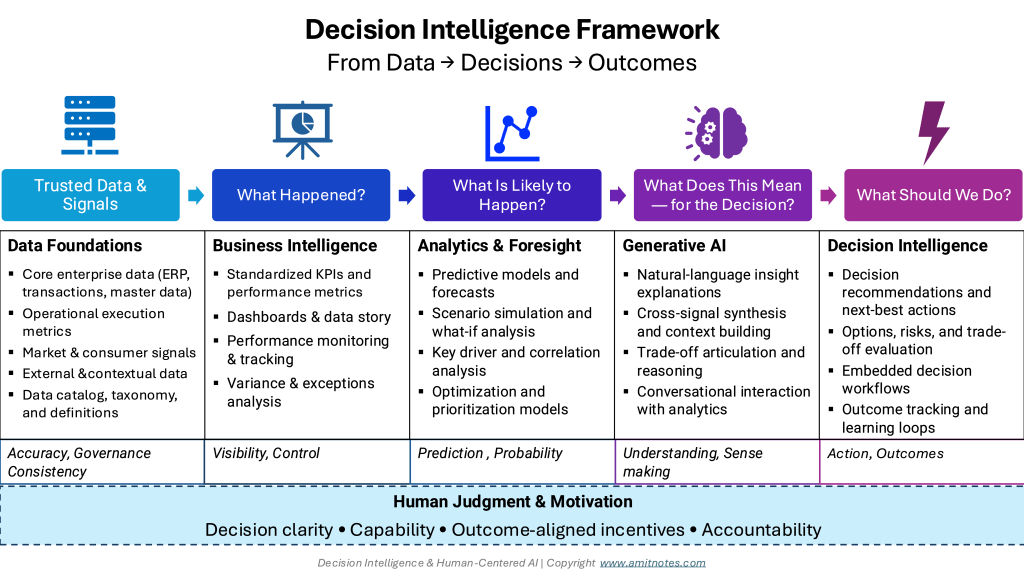
Each layer builds on the previous one. But value does not increase evenly. It compounds only when insight is intentionally designed into decisions, rather than left to interpretation. Reading the framework from left to right reveals how this shift happens.
1) Trusted Data & Signals: The Foundation of Credibility
Every decision system begins with data, but not all data is decision-ready. Trusted Data & Signals represent the raw inputs that define an organization’s understanding of reality. This includes transactional data from operations, market and consumer signals from external sources, operational metrics from execution, and broader contextual inputs such as economic or competitive factors.
The purpose of this layer is not insight. It is credibility. When accuracy, governance, or consistency are weak, leaders instinctively question everything that follows. Insights are debated instead of acted upon. AI outputs are mistrusted. Decisions slow down before they even begin. Trust is not a technical requirement. It is a leadership requirement.
2) Business Intelligence: What Happened?
Business Intelligence answers the most basic and essential question leaders ask: What happened? Dashboards, reports, KPIs, and performance scorecards provide a shared view of results. They surface trends, highlight variances, and create a common language for discussing performance across the organization.
This layer delivers visibility and control, and it remains indispensable. But BI has a natural ceiling.
Dashboards describe performance, but they do not prioritize what matters most right now. They highlight gaps, but they do not resolve trade-offs. Most importantly, they stop short of answering the question leaders ultimately care about: What should we do differently? At this point, insight leaves the system and decision-making becomes manual, subjective, and inconsistent.
3) Analytics & Foresight: What Is Likely to Happen?
Analytics extends BI from hindsight into foresight. Forecasting models, scenario simulations, driver analysis, and optimization techniques help organizations anticipate future outcomes under different conditions. This layer improves preparedness and reduces surprises by shifting the conversation from reacting to the past to anticipating what may come next.Still forecasting or predictive models alone rarely creates action.
Probabilities still require interpretation. Scenarios still require choice. Optimization models still require trust. Leaders may understand what is likely to happen, but they often struggle with deciding which path to commit to and which risks to accept. I see organizations are not constrained by analytical capability. They are constrained by decision clarity.
4) Generative AI: What Does This Mean — for the Decision?
Generative AI introduces a new capability into the analytics stack: sense-making. Rather than producing more charts or more numbers, Generative AI helps translate data into business language. It synthesizes signals across multiple sources, provides contextual reasoning, and articulates trade-offs that are often buried across dashboards and analyses.
This enables analytics systems to participate in the thinking process, not just the reporting process. Business users can interact with insights conversationally, explore implications in real time, and move faster from understanding to alignment. But clarity alone does not guarantee better decisions. Deeper insights and reasoning should lead to actions to generate real business outcome.
5) Decision Intelligence: What Should We Do?
Decision Intelligence is where the shift becomes real. This layer is explicitly designed around decision moments, not reports. It frames decision options, clarifies risks and trade-offs, and embeds recommendations directly into decision workflows—rather than leaving choices to interpretation after the fact.
Equally important, Decision Intelligence closes the loop. Decisions are tracked, outcomes are measured, and learning feeds back into future recommendations. Over time, this creates consistency, accountability, and institutional learning.
Decision Intelligence is not about automating decisions or replacing human judgment. It is about making high-quality decision-making repeatable at scale.
Human Judgment & Motivation: The Constant Across All Layers
Beneath every layer of the framework sits a critical truth: decisions are ultimately human. Context, experience, incentives, and accountability shape how decisions are made and whether insights are acted upon. No amount of data or AI can override these forces.
Most AI initiatives fail not because models are wrong, but because the human system around them is misaligned. Decision Intelligence works only when people choose to engage—and choose to act. AI does not replace human judgment. It amplifies it, when designed with intention.
What Changes When Organizations Make the Shift
When organizations move from Business Intelligence to Decision Intelligence, the change is visible in everyday operations / business activities. Dashboards evolve into decision workflows. Reporting gives way to action guidance. Metrics become decision signals rather than static scorecards. Success is measured by outcomes and accountability, not just adoption or usage. Insights are no longer delivered and forgotten. They are acted upon, reviewed, and learned from.
The move from Business Intelligence to Decision Intelligence is not a technology upgrade. It is a leadership discipline—one that determines how consistently organizations turn insight into action. The organizations that succeed will not be those with the most dashboards, the most models, or the most AI tools. They will be the ones that deliberately design data, analytics, and AI around how humans think, decide, and act. That is the real evolution of Business Intelligence—and the real promise of AI.
 AmitNotes.com
Leave a comment